Monday, 11 June 2012

Invisible: Art of the Unseen 1952-2012 at the Hayward Gallery, London


Tomorrow the Hayward Gallery are opening an exhibition of 'invisible' art. However dubious I was about this in concept and execution before I went, I would say that it is definitely worth a visit. 

Yes, that right, these are framed white pieces of paper. The one of the right that you can barely see? That is a rubbed out Playboy centre fold. All three by Tom Fieldman.

Andy Warhol once stood on this plinth, could I still feel his celebrity presence? I would say no, but an interesting concept.


So is this what happens you put on an invisible exhibition, you get invisible visitors?!!!! To be fair we were at the press view, I just can't see this exhibition pulling in the crowds. Especially when you are essentially paying £10 to look at some blank walls.

'Invisible: Art of the Unseen 1952-2012' runs from 12th June until 5th August 2012. Tickets £10.
http://ticketing.southbankcentre.co.uk/find/festivals-series/invisible-art-of-the-unseen-1952-2012


Wednesday, 23 May 2012

Some Reflections on Lucian Freud: The Hype and the Reality


By Ally Crossland

Nowadays, the British public are bombarded with the Lucian Freud image. His portraits seem to be everywhere, making a big splash in the exhibition world as well as the auction houses. The National Portrait Gallery’s blockbuster Lucian Freud Portraits has certainly drawn in the crowds. In fact it has been the galleries most successful show ever, receiving over 175,000 visitors through its doors. Its popularity has no doubt been helped by a visit from the ever glamorous and on trend Duchess of Cambridge. Freud has long been seen as the saviour of British Art, one of the most revolutionary artists for generations. Some claim the hype of the Lucian Freud brand has outshone the brilliance of his raw and uncompromising talent. Others feel, as one online sources comments, that Freud was an ‘ugly painter, of ugly people’.

Yet, in my humble opinion, no better accomplished and talented artist could have been given the honour of almost the entire lower floor of the National Portrait Gallery, in which to hang perhaps the most important retrospectives of the last few years. Possibly not since the Francis Bacon exhibition at the Tate in 2008 has such an important retrospective focused on the work of one British artist working in the twenty-first century.

Freud's early portrait of his first wife Kitty
From the exquisitely detailed portraits of his youth, with electrically charged eyes and doleful expressions, Freud showed prolific talent. As an artist his penetrative gaze allowed him to access the inner qualities of the sitter. He revealed the secrets about them that they would rather keep hidden, laid bare and uncompromised on the canvas.

In Freud’s later portraits he did away with any pretence of formality, stripping the sitter to the bare bones and flesh that make up what it is to be human. Whether clothed or nude, Freud’s sitters are depicted in the most brutal yet sensitive way. Contorted into uncomfortable positions, their faces un-idealised, mournful and pensive, Freud’s sitters reflect real people and emotions that can be seen and felt in today’s world.
Life model Sue Tilley and 'Benefits Supervisor Sleeping'
Two of Freud's last portraits, with 'Portrait with Hound' 2011 on the right
The bodies in Freud’s portraits become swathes of raw pigment forced onto the canvas. Faces are contorted by age or an inner complexity that will never be fully realised by the spectator. What Freud achieves is a realness that other portraitists would never dare to address. He claims the subject for himself and enters into a relationship with the sitter, part trust and part animal attraction. His later works, even the painting Portrait with Hound, painted up until Freud’s death in 2011, shares this same brutal honestly. Yet it is also beautifully poignant. This unfinished portrait finishes mid-sentence, leaving the spectator to fill in the blanks. In a sense this is quite apart from the rest of the exhibition, which successfully depicts all the different stages of Freud’s life through his paintings. The paintings, which so define Freud’s life, speak for themselves, and in my opinion find a voice within the walls of the National Portrait Gallery. They may be ‘ugly’, but in the same breath they are truly exquisite reflections of the very real people that made up Freud’s world.

Lucian Freud Portraits runs at the National Portrait Gallery until the 27th May 2012.Admission £14. Concessions £13 / £12 With Gift Aid (includes voluntary Gift Aid donation of 10% above standard price): Admission £15.40. Concessions £14.30/£13.20

Saturday, 5 May 2012

Art Crush: William Dobson

Apologies for the lack of posts recently, dissertation lock down has only come to be replaced with finals lock down! Only two weeks to go and then frequent posting shall resume.

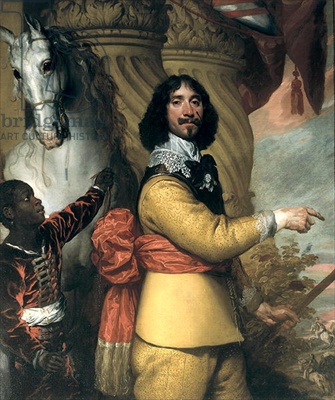
Meanwhile, in the course of my revision I have discovered by latest artist obsession in the work of one William Dobson. Dobson was Charles I's principle portraitist who painted the monarch and his followers during the Civil War. For me, his works have a bold brilliancy that is utterly captivating. Dobson used simple compositions, quite different from the often outrageously ostentatious ensembles that were favoured by Van Dyck; who he was greatly inspired by. You can see his self portrait here:


 Dobson was clearly inspired by Van Dyck's self portrait, which belongs to the Philip Mould Gallery. Nice frame huh?!


Below is one of Dobson's portrait of Charles I's most loyal cavaliers, Colonel Richard Neville, painted c.1643. Dobson often adopted simple yet effective symbolism to show the beliefs of the sitter. Here Neville is seen swathed in the bright red cloth that showed him as an out-and-proud Royalist. His helmet and gun are ready to be picked up and taken out to the battle field which is depicted behind him. The dog represents loyalty to the crown.


Finally, this is my favourite. Check out Lord Byron's ancestor! Another clear reference to Van Dyck in the column and the horse. Here Byron is showing off the war scar on his face, and pointing down to the battle scene with his baton of office. Instead of actually joining in the battle of course.


Wednesday, 14 March 2012

David Hockney: Nature on Acid?

The Royal Academy’s latest blockbuster showcases a colossal selection of works by David Hockney RA, portraying his career long engagement with the natural landscape. Much of the exhibition is taken up with large-scale works depicting the landscape of Hockney’s childhood in the Yorkshire Wolds. Hockney’s manipulation of space is translated to the canvas through broad swathes of lurid colour giving the works a mesmerising, almost hypnotic effect. His fearless use of bright colours to construct the natural beauty of the British countryside is reminiscent of the Impressionists bold application of unmixed pigments.
'Winter Timber 2009'
 Hockney’s daring use of colour is joyful, full of energy and promise. Many of the works are large-scale rural scenes, and are arrangement of several canvases placed together. The work that has been assaulting our eyes from Tube posters for months, ‘Winter Timber 2009’ has every crevice of canvas filled with vivid colours, a long line of trees drawing us in through the winding path. These floor to ceiling works have an almost Rothko-esque effect. The spectator is sucked into a whirlwind of colour and movement.

'Three Trees near Thixendale Winter 2002


Several scenes are repeated a number of times, each depicting a different season. Here, Hockney’s incredible use of colour comes into its own, using blood orange and berry red for autumn, then soft lavender and palest blue for spring. The collage of paintings that depict different countryside scenes in Yorkshire create an aura of peace and tranquillity, yet the expressive use of colour gives them an energy and alertness that sums up an almost child-like enthusiasm. This celebration of a very British image seems to tap into a distinct nostalgia for a re-engagement with nature itself. Indeed these Yorkshire landscapes are reminiscent of any countryside walk in Britain, and certainly reminded me intensely of my childhood in Wiltshire. This shared experience of the natural world makes it easy for people to relate to Hockney’s work.
One of Hockney's Ipad paintings


Hockney also engages with new mediums that succeed in bringing his depiction of the natural landscape into the 21st century. His much anticipated ipad paintings have created quite a stir. In a time when many artists are rejecting the proliferation of new media as something that downgrades the art of sketching and drawing, Hockney embraces it with open arms. With around fifty of these ipad creations increased in size and printed on paper, it is like stepping into a forest gland in a soft summer light. However, I feel these ‘paintings’ lack the intensity and passion of his oil works, and seem to be really about engaging new audiences with exciting new mediums.


Another medium I feel was much more successful was his use of video art as a highly evocative insight to the peace that can be experienced when contemplating a countryside scene. With eighteen individual video panels displaying a different time frame for the same woodland scene, the distorting movement cleverly recreates the movement of the trees being blown by the wind. In this way, it is much more indicative of the multi point vision that we actually use to see the world around us.   

Hockney has undoubtedly succeeded in reconstructing the nostalgia of the natural world for the 21st century audience. His works do not shy away from making a statement, and his joyful use of colour effectively construct a positive nostalgia for the British countryside. The vibrancy of his works are utterly captivating, and his almost paint-by-numbers technique is a bold and modern approach to the depiction of the traditional landscape.

Monday, 12 March 2012

What are the Issues Raised by the Ethnographic Displays at the Pitt Rivers Museum?


The Pitt Rivers Museum houses one of the most important collections of anthropological and archaeological objects in the country. The museum can be seen as a fascinating insight into foreign cultures and traditions, as ‘a new way of looking at the ordered cosmos’. Yet it can also been argued that it is a Colonial treasure chest of objects taken from their indigenous origins and used to highlight the ‘truth’ of evolution and the progression of the human species. Are there ‘truths’ revealed in the Pitt River’s museum display?

The Pitt Rivers Museum in Oxford was founded in 1884 by a leading anthropological figure of the day, General Pitt River, who donated his collection of 18,000 objects to Oxford University. Now the collection has reached over half a million, and is housed in an impressive Victorian building. The entrance is now through the Oxford University Museum of Natural History, where you enter to a low lit court with a large totem pole dominating the space. The original explorer or anthropologist donated many of the objects, and hundreds of objects are crammed into the original display cases.

The layout of the museum is unusual in that instead of housing objects together by country or culture, they have been divided into rough ‘types’. For example in the ‘Animal Forms in Art’ cabinet, you see small animal sculptures from Malaya, next to Canada, next to Greece next to China. This decision was originally due to the influence of Pitt Rivers himself, who wanted the museum to have an evolutionary purpose, and to show how societies evolve from simple to complex.

In effect, this method completely de-contextualises the objects, and distanced from their original purpose, they take on a new meaning within the museum complex. They take on the role of defining the foreign cultures on show as the ‘Other’ to the sophisticated European society.  On display there are few European objects, and even less from Great Britain.

In 2009 the museum re-opened after a ten-month long overhaul, in which more of the original display was re-established. The now dimly lit central court is explored by torches which are provided by the museum. This gives a sense of adventure to visitors’ self guided visit, and is especially popular with the children, who are further involved in the museum experience with craft activities, trails and activities sheets. As there are no long winded descriptive panels, you are left to draw your own conclusions as to the origins and uses of the objects

Another issue raised in this museum space is the treatment of sensitive materials, which originally had magical or religious purposes. One of the most visited displays at the Pitt Rivers is the ‘Treatment of Dead Enemies’, which has so many objects it needs two display cases. These seem to be constantly surrounded by curious spectators. One case in particular houses examples of skull trophies taken by various tribes, many from New Guinea, as well as the famous shrunken heads from the Upper Amazon. This ghoulish spectacle certainly draws in the crowds. However, this display raises questions about the origins of these objects. Now objects of curiosity, they were once living being, and this creating this spectacle of death could be seen as insensitive and disrespectful.


Exploring the darkened cabinets of the Pitt Rivers is undoubtedly a fascinating adventure. Yet it raises questions about what voice it gives the original claimants of these objects. I personally think, even in the limited space, more could be done to contextualize these objects. Without it, this collection of material culture could be forming a Colonial-esque outlook which silences those cultures considered to be less civilized and less advanced. Do the original cultures still have a claim to these objects, or have they become part of the makeup of this museum? Despite the aim of the museum to have an educational purpose, these objects to do necessarily teach truths without context and instruction. They become objects of exotic beauty and fantasy, almost passing into the realm of fiction.

Saturday, 10 March 2012

Ahmed Mater at the British Museum


Hajj, Journey to the Heart of Islam is a rare insight into the spiritual journey undertaken by millions of Muslims each year to the city of Mecca. The Hajj is one of the five pillars of Islam; and is a pilgrimage that should be undertaken at least once by every Muslim, if they are able. Once they arrive at Mecca, they complete a number of different rituals over a period of days, each one bringing them closer to the prophets. One of the most visually striking is the tawaf- where millions of Muslims join as one in the sanctuary at Mecca, and circumambulate the central ka’ba, a black box in the centre of the space, seven times anti-clockwise. This tradition goes back as far as the time of Abraham and Ishmael themselves, who are said to have walked around the Ka’ba seven times after they had rebuilt it.

Pilgrims praying to the Ka'ba

 What I found most striking about this exhibition was the work of contemporary artist Ahmed Mater. His works entitled ‘Magnetism’ are wonderfully simple yet perfectly evoke the intimate connection that Muslims feel when they complete the tawaf. In his works, the Ka’ba is recognisable as a magnetic block, and thousands of iron fillings are used to represent the pilgrims, but also the magnetic nature of this most holy of objects. They form beautiful circular patterns around the central block. The large photographic images of these small installations were quite exquisite, and in themselves became almost magnetic.

Ahmed Mater 'Magnetism (Photograuve) I
http://www.britishmuseum.org/whats_on/exhibitions/hajj.aspx
The exhibition runs until the 15th April 2012. Tickets £12, free for Friends. 
Ahmed Mater's website: http://ahmedmater.com/

Sunday, 26 February 2012

Who could resist another day of procrastination with such fine spring weather?

Van Dyck in Sicily 1624-5 Painting and the Plague 

Today James and I headed off on a short train ride from Victoria, to see what Van Dyck got up to when he spent a year in Sicily in 1624. This was under the guise of 'revision', despite our finals being months away. The truth of it was, we couldn't stand to write essays with such unexpectedly fine weather. 


Van Dyck, 'Philibert of Savoy, Prince of Onegalia' 1624
Dulwich Picture Gallery has gathered some thirteen or so fascinating Van Dyck’s into a collection from this short period of  his production. The first room showed Van Dyck's prowess as portrait painter to the elite. The exquisite portrait of the (well named) Emmanuel Philibert of Savoy, Prince of Oneglia, shows the prince decked out in some seriously impressive armour, which is also on display. Two huge devotional paintings take up most of the next room, one a reclining John the Baptist, the other a colossal stoning of St. Stephen. These impressive works show the sheer star quality of Van Dyck. Their sophistication in form and movement speak of Rubens and Titian, but definitely bring something new of their own.

Van Dyck's 'Saint Rosalie' 1624
Whilst Van Dyck was in Palermo, the island was struck with an plague epidemic so bad that much of the population was decimated. Van Dyck’s response to this disaster was to paint several versions of St. Rosalia, who was seen as the intercessor for the plague victims. Her cult became enormously popular after her remains were supposedly discovered in a cave in 1624. Her reliquary is still annually paraded into the city to this day. Van Dyck transformed this 12th Century monk-recluse into a beautiful, angelic woman with flowing locks of golden hair. The city behind her appears dark and foreboding, but she brings hope through her devotion to God.


Overall the exhibition would be part of a great day out in sunny Dulwich, and is just a small part of an impressive collection of Old Masters that the gallery has collected.


The exhibition finishes on the 27th May 2012. Tickets cost £10 when brought in conjunction with an exhibition ticket for ‘Ragamala: Paintings from India’. £5 for students. www.dulwichpicturegallery.org.uk